
Santa Rosa, CA · Garage Door Service
Garage Door Panel Replacement in Santa Rosa
Dented or cracked garage door panels are common on Santa Rosa's 1960s-70s housing stock. See what drives panel failure here and what a repair job actually involves.
- Repairs & new doors
- Springs & openers
- Serving 8 nearby communities
What You Pay
We're not going to put a number here that doesn't hold up once a tech is standing in your driveway. Panel cost depends on the door's width, whether it's a steel sandwich panel or a thinner single-skin section, and whether your door is even still in production - a lot of the doors on Santa Rosa houses built between 1938 and 1993 came from manufacturers that have since changed their panel profiles twice over. If your door is a common width and a current model line, swapping one panel is usually straightforward. If it's an older or discontinued line, you may be buying a full replacement door because the manufacturer no longer makes a matching panel, and that changes the math entirely. The honest answer: get a tech out to measure the door and check the panel code before you plan a budget around a figure you found online. We'll tell you straight if a single panel swap makes sense or if you're better off replacing the whole door, including when the labor to match an obsolete panel costs more than a new one would.
Can You Do This Yourself
A single bottom panel on a sectional door is sometimes a DIYable job if you can source the exact matching panel, get the door off its track safely, and reset the roller brackets without bending the new section during install. That's three separate ways to turn a one-panel repair into a two-panel repair. Where it gets genuinely risky is torsion spring tension - if your panel damage is near the bottom corner where the cable runs, you're working close to a loaded spring system, and that's not a place to learn on the job. We also see homeowners order a panel by color match alone and find out the mounting holes or rib spacing don't line up, because Santa Rosa's older housing stock carries several now-discontinued panel profiles. If your door is newer and the panel is a cosmetic dent with no cable or track involvement, it's a reasonable weekend project for someone comfortable with basic tools. If there's any bowing, cracking through the panel, or involvement of the bottom cable, call it in.
Why It Happens Here
Most of the housing across this service area went up between 1938 and 1993, with the bulk of it dating to the 1960s and '70s - that's the era when steel sandwich panels with a thin foam core were standard, and those cores break down with age regardless of how well the door's been maintained. Add a mild temperate climate without the deep freeze-thaw cycles that crack concrete elsewhere, and you'd expect these doors to hold up fine, which is mostly true - until you look at what actually fails. It's usually not weather damage. It's the accumulated dings from decades of daily contact: a bike pedal, a trailer hitch, a kid backing out the car. On an original-era panel, that dent doesn't pop back out the way a newer, thicker-gauge panel would, because the foam core has gone brittle and the steel skin has lost its memory. Across the 28 named areas we cover in this region, the panel failures we see track almost exactly with the age of the house, not with storm damage or heat - which is a different repair conversation than garages in places with harsher winters or more seismic cladding stress.
What You Are Seeing
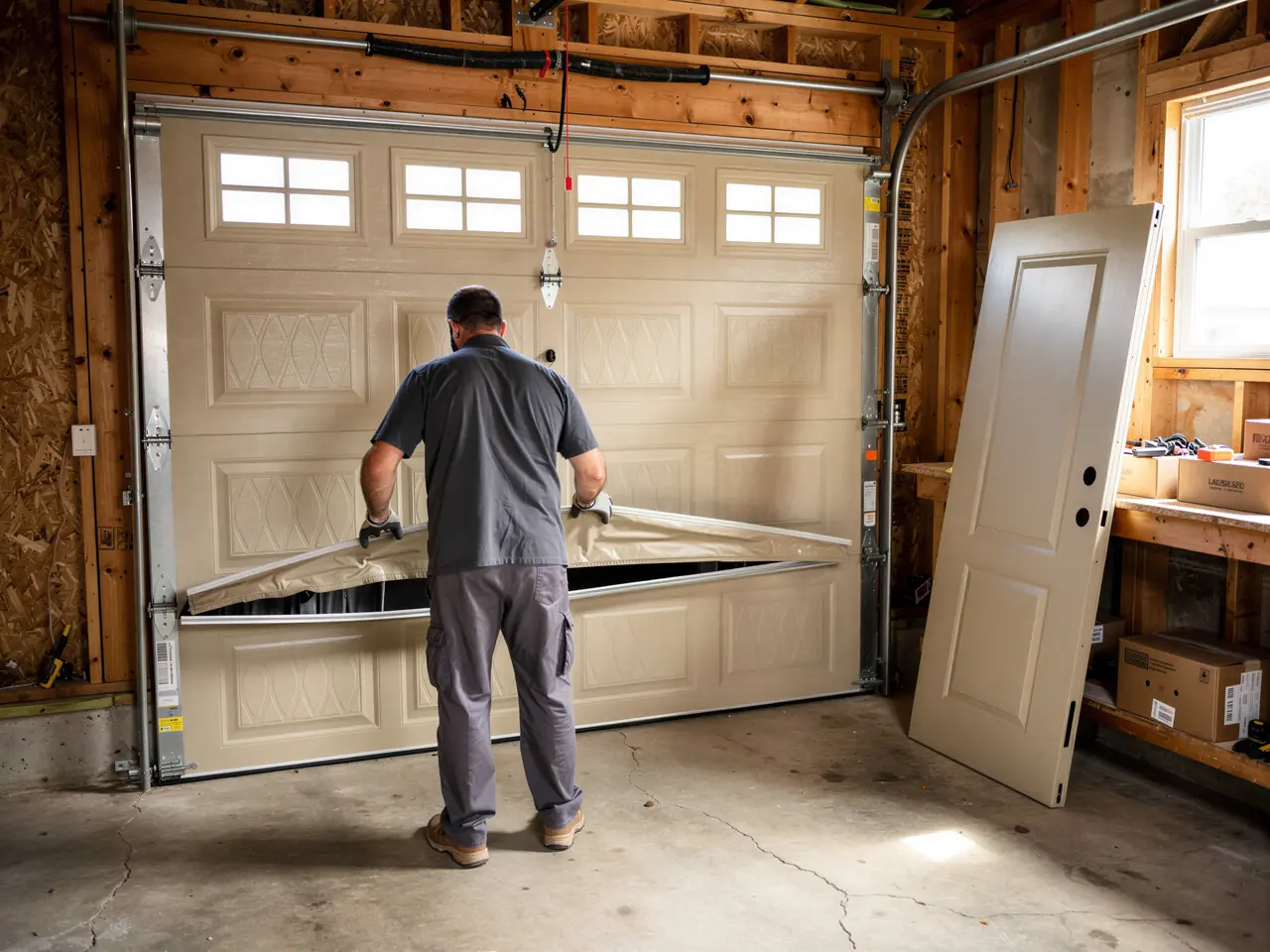
A bowed or dented bottom panel is the most common call - usually from a vehicle bumper tap, and usually on a house old enough that the panel is original. You'll also see a crack running along a rib on a single-skin panel, which tends to show up on older, pre-1993 doors more than newer double-skin ones. Rust bleed along the bottom edge of a panel is common on doors that sit low near grade without much drainage slope, though we can't tell you how common that specific scenario is without seeing your setup. Delamination - where the steel skin separates from the foam core and the panel feels soft or flexes when you press it - shows up almost exclusively on the older stock from this area's 1960s and '70s building boom, since that's when the sandwich-panel construction method was still being refined. If you're seeing daylight gaps between panels when the door's closed, that's usually a track or hinge issue riding alongside the panel damage, not the panel itself - worth mentioning before you order a part that won't fix the actual problem.
Frequently asked questions
Can I replace just one panel instead of the whole door?
Often yes, if the manufacturer still makes that panel profile and the rest of the door's hardware is in good shape. The catch is sourcing: doors built in the 1960s-70s boom that shaped most of this area sometimes used profiles that are no longer made, which can push you toward a full door swap instead.
Why does my panel look fine but feel soft when I push on it?
That's usually delamination - the steel skin separating from the foam core inside. It's common on older sandwich-panel doors from this area's housing stock and doesn't always show visible damage until the panel starts flexing or the paint bubbles.
Does Santa Rosa's climate cause panel damage?
Not directly. The mild temperate climate here doesn't put doors through the freeze-thaw stress that cracks panels elsewhere. Most of what we see is physical impact damage showing up on older panels that have lost their flexibility over the decades.
How do I know if it's worth repairing versus replacing the whole door?
If the panel is discontinued or the damage runs across more than one section, a full door often costs less than custom-matching old panels. A tech checking the panel code and door age on site can give you a straight answer faster than guessing from photos.
Related services
By Neighborhood
Panel Replacement across the Santa Rosa area
We also handle panel replacement in these Santa Rosa-area suburbs.
Book garage door service in Santa Rosa
Call now or request a quote - tell us what the door is doing and where you are.