Santa Rosa, CA · Garage Door Service
Garage Door Repair in Santa Rosa
Garage door repair for Santa Rosa homes built mostly between 1938 and 1993, where original torsion hardware and mild coastal humidity wear springs and rollers the same way.
- Repairs & new doors
- Springs & openers
- Serving 8 nearby communities
What You Pay
We're not going to throw a number at you that doesn't mean anything until a tech has the door open. Cost on a repair call comes down to what's actually broken - a cable, a roller, a torsion spring, or the opener logic board - and whether the part is still stocked for your door's age. In Santa Rosa, a lot of that stock question matters more than it would somewhere with newer housing: F1 shows homes here were built mostly between 1938 and 1993, median year 1972, so a fair share of doors still running are on older torsion setups or early-generation openers. Parts for those exist, but they're not always the first thing on the truck. What we can tell you without a price is this: a spring replacement is a smaller job than a full door and track swap, and a service call where we're just re-tensioning a cable or swapping a roller costs less than either. If your opener is original to a 1970s build, replacing it is often the more sensible move than chasing a part for a board nobody makes anymore - that's a judgment call we'll walk you through on site, not sell you into.
Can You Do This Yourself
Some of it, yes. Tightening loose hardware, lubricating hinges and rollers, clearing a photo-eye sensor that's knocked out of alignment - those are fine weekend jobs. A torsion spring is not. Torsion springs hold enough stored tension to break a wrist or worse, and on the older hardware common in homes built in the 1972 range typical of Santa Rosa, the mounting brackets themselves can be fatigued in ways you can't see from the floor. Cable work has the same problem - a cable under load that slips off a drum can take a finger with it. If the door won't open, won't stay open, or makes a bang and drops, that's a call, not a project. We'll say plainly: if you're comfortable with hand tools and the fix is a sensor, a hinge, or a bent bracket on the track, go ahead. If it involves anything holding tension - springs, cables, the torsion bar itself - that's where we draw the line and where you should too.
Why It Happens Here
Santa Rosa's housing stock skews old by garage door standards - F1 puts the build range at 1938 to 1993 with a median around 1972, and F2 notes that the mostly 1960s-70s stock shows up across all 28 named areas we work in, not just one pocket of town. Doors and openers from that era were built to last, but springs, cables, and rollers are wear parts regardless of how well the door around them was built, and thirty, forty, fifty years of cycles catches up with them. The climate here doesn't help in the way people expect - F3 puts us in a mild temperate band, so we're not dealing with freeze-thaw cracking or extreme heat warping panels the way harsher climates do. What we see instead is slow corrosion on galvanized hardware from the region's damp winters and steady humidity swings, which pits springs and cables gradually rather than snapping them outright. That's why a spring on an older Santa Rosa door tends to weaken and sag before it breaks clean, giving you warning if you catch the slow-close symptom early.
What You Are Seeing
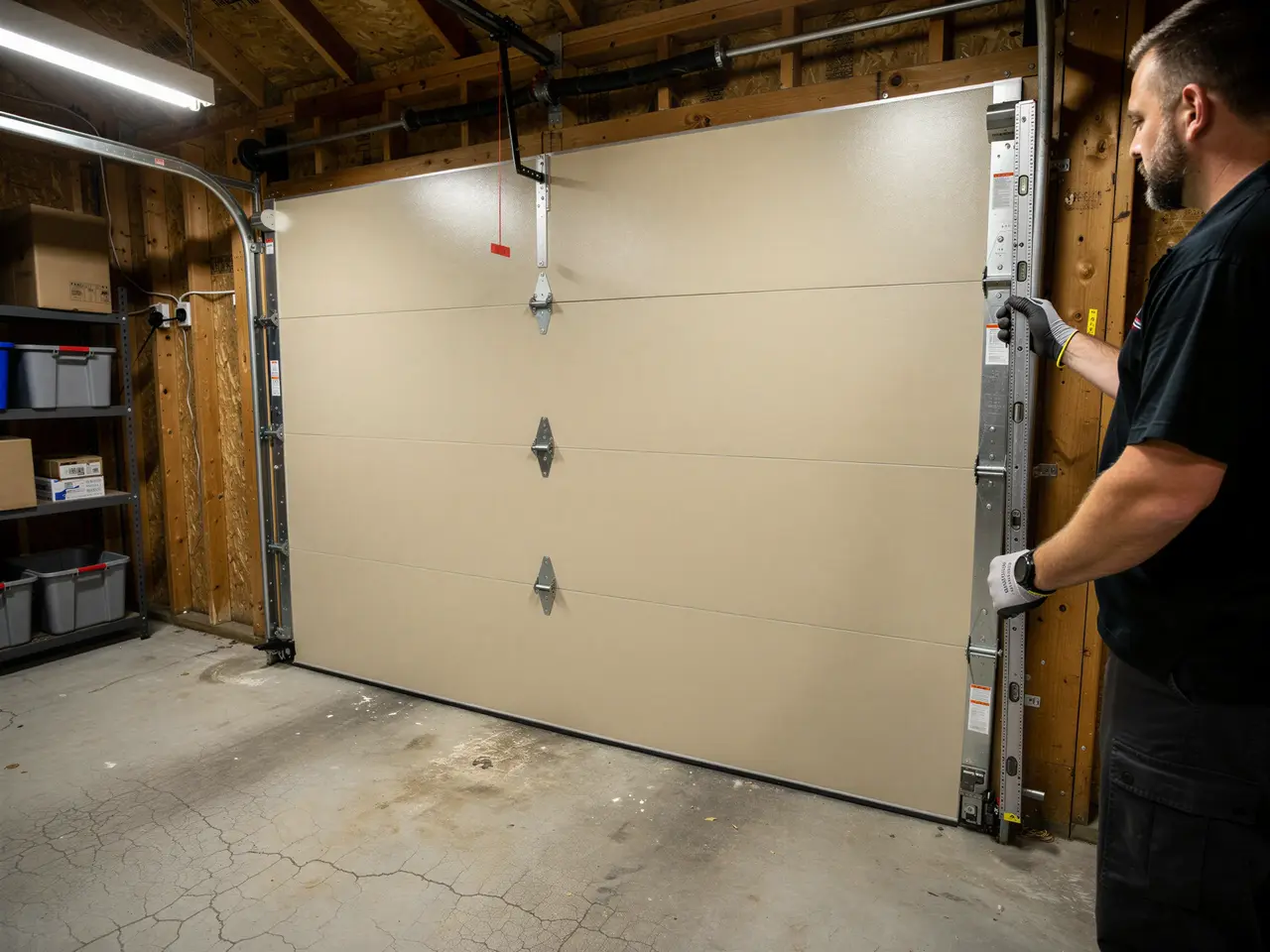
If your door is sagging unevenly when it closes, that's usually one spring losing tension before its twin does - common on the two-spring torsion systems original to houses from the 1960s and 70s era that make up most of this market. A door that's suddenly heavy to lift by hand, or an opener straining and reversing partway, points the same direction. A loud bang followed by the door refusing to move at all is almost always a broken spring, full stop - don't force it, and don't let anyone stand under it. Rollers that grind or squeal as the door travels are wearing out, and on older track systems that's often paired with a bent track section from years of slightly-off alignment. If the opener runs but the door doesn't move, or moves and reverses, check the photo-eye sensors near the floor first - they're cheap to fix and get knocked out of alignment more often than people expect. None of these are emergencies you have to sit with; a sagging or grinding door only gets worse.
Frequently asked questions
Why do garage doors in Santa Rosa seem to fail around the same age?
Because so much of the city's housing went up in the same stretch - F1 shows a build range of 1938 to 1993 with a median around 1972. Doors and openers installed with those houses are now decades old, and springs, cables, and rollers wear out on a predictable cycle regardless of how solid the original door was.
Does Santa Rosa's climate cause garage door problems?
Not in the dramatic way freeze-thaw or extreme heat does elsewhere. F3 puts the area in a mild temperate band, so the bigger factor is steady humidity slowly corroding galvanized springs and cables over years rather than sudden weather damage.
Should I repair or replace an old opener?
If it's original to a 1970s-era house, a replacement part may not exist or may cost nearly as much as a new opener. We'll check what's available for your model on site, but older boards are often the case where replacing beats repairing.
What should I never try to fix myself?
Anything involving stored tension - torsion springs and cables under load. These can cause serious injury if they release while you're working on them. Sensor alignment, hinge tightening, and roller lubrication are fine DIY tasks; spring and cable work is not.
By Neighborhood
Garage Door Repair across the Santa Rosa area
We also handle garage door repair in these Santa Rosa-area suburbs.
Book garage door service in Santa Rosa
Call now or request a quote - tell us what the door is doing and where you are.